Radiohead embracing Scene releases (and DIY guerilla marketing) with leak of new single?
1 comments at Sunday, August 16, 2009With a forthcoming EP on the cards, recent events could prove to be another masterstroke of marketing genius from Radiohead - or at the very least, a nod to the darknet release scene which has been around since the days of BBSes. Either way, one band is once again making waves across the Internet...
It hasn't escaped many people's attention that a new Radiohead single, "These Are My Twisted Words", was leaked onto the web on the 14th of August. One of the first places for it to crop up was on the private BitTorrent trackers; What.CD's entry for the track currently has over 2,400 discrete downloads of the .torrent.
The filename of the track itself? "01-radiohead-these_are_my_twisted_words-(advance)-2009-woi.mp3". "woi" stands for WallOfIce, as detailed in the release's accompanying nfofile. (update: what appears to be vaguely official artwork can be seen on @Yussavoice's twitter profile background...)
Of course, the band has remained staunchly silent on this development - and the silence to some has been a deafening confirmation that they're behind the whole thing. Of course, almost immediately after the track's leak, the release was analysed and dissected by RH fans all over the world. The article on GreenPlastic documents just how many people picked over it with a fine toothcomb, as well as the original author putting forward some of his own theories as to what exactly this 'release' means in terms of marketing and advance notice of a full-blown release.
Radiohead have stated in the past that they won't be doing more full albums for a while, as mentioned by AtEase. York himself said;
“None of us want to go into that creative hoo-ha of a long-play record again. Not straight off. I mean, it’s just become a real drag. It worked with “In Rainbows” because we had a real fixed idea about where we were going. But we’ve all said that we can’t possibly dive into that again. It’ll kill us.”
Although some have dismissed the EP launch as mere hyperbole from AtEase, I believe it could be quite the opposite. Personally, I'm in agreement with the consensus that this is actually a legitimate 'leak' by the band, as the facts are stacked in favour of this once they are examined closely. Why? Well, let's examine the facts:
- The release is tagged with a "-woi" groupname, but no prior evidence of this group's existence is available across the Internet, even when using the pre search engines
- Using EncSpot, the encoder is shown to be a VERY old encoder called GoGo (a variant of Lame, and not pure Lame itself which the scene rules mandate), as well as having an ID3v1 Genre tag of "Blues"
- The domain WallOfIce.com conveniently points to the W.A.S.T.E. store (more below)
The metaphor is strong with this one: not only does this leak coincide with a rumoured EP launch next week, the name "Wall Of Ice" has been interpreted by some to be a veiled xkcd reference, where the cartoon strongly mirrors the band's apparent own sentiments towards the record industry:
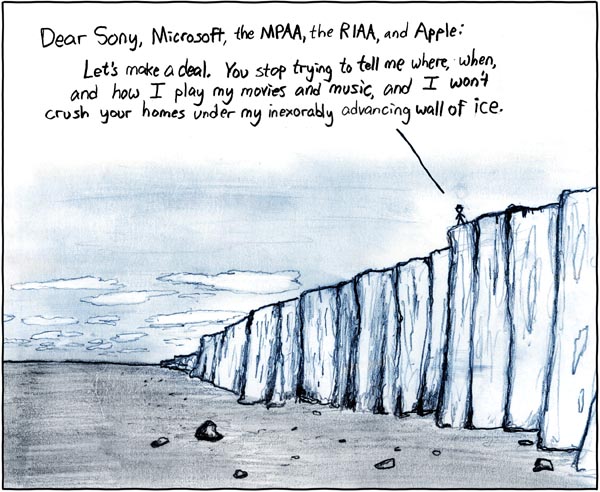
If this isn't enough for you, the domain WallOfIce.com (which redirects to the W.A.S.T.E. store) was created on the 14th of August - the same day as the track's leak - and has the registrant's whois information clearly visible:
Registrant: Versio
Contact: Reshad Bashir () +31.0645252730
Address: Raaigras 271, Leeuwarden, 8935 GD, NL
Reshad Bashir is a sysadmin for Versio, so he (or his company) has registered this domain on behalf of someone and his details have been put in there. Stereogum's already discussed this at length. No scene group member would be stupid enough to put personally-identifying details into a public whois record. Radiohead haven't registered the domain name directly, but it would make sense not to do so in order to stir up a bit more discussion and controversy over what it exactly means. Of course, this may all just be coincidence - someone registering the domain *after* the leak was made available on the Internet, and not done by the band - but it seems somewhat unlikely.
For the record, the most recent Radiohead scene release from an official group is a webrip of their Harry Patch tribute single: "Radiohead-Harry_Patch_(In_Memory_Of)-(Web)-2009-SiREx".
Summing up, these events can almost certainly be taken as proof once again that Radiohead are: 1) masters of drumming up Internet buzz, 2) completely in touch with their inner nerd, and 3) they 'get' the Internet a little more than some might think. They've always been in touch with their online presence; waste.uk.com was registered in 1998, nine months before even I had my own web site. Since then, they've overcome their signing to EMI, they've rapidly embraced the Internet and they've even conquered the question of variable pricing by just forging ahead and doing it off their own backs.
Now they're mimicking the release scene... Perhaps we'll see more future Radiohead releases leaked in the same way? They're certainly not the first band to leak their music via the Web, but it's quite clever of them to do it in such a way that it'll almost certainly fool those who aren't completely familiar with the usual behaviour of the MP3 release scene. Really, you can only commend the band for trying something new - this is guerilla digital marketing, and there's no telling just how much coverage they'll get from this once the mainstream media picks up on this. Personally I'll be very surprised if we don't see an EP release next week.
An aside: I have one problem with Radiohead's digital releases - if they're still using GoGo-no-coda, which is based on a version of LAME dating back to 2004, the sonic quality of their MP3s (even at 320kbps) is going to be vastly inferior compared to if they were encoded using the very latest stable builds of LAME. For this reason alone, I'll keep on buying CDs and ripping them myself (usually to FLAC).
(PS: if Thom / whoever encodes the MP3s for sale: drop GoGo! It's obsolete and the version of LAME it uses has been superceded. Get Frontah, drop in the v3.98 stable build of lame.exe into the Frontah working directory, and if you don't want 320kbps files, use the encoding paramters "-V1 --vbr-new" to encode your audio to transparent VBR files. Mmmm, sounding tasty!)
Update, 16/08/2009: someone at The Guardian has written a woefully mistake-ridden article on the same thing - and stupidly linked to the torrent on the private tracker what.cd as well. Read and enjoy: http://www.guardian.co.uk/music/2009/aug/14/new-radiohead-song

Today marks the birthday of Hans Christian Ørsted, the man who discovered that electricity affected magnetic fields. Or, in other words, the principles on which great things were built and which now (literally) power our civilisation.
The Guardian's article, 'Hans Christian Ørsted gets Google Doodled', is a great read if you knew nothing about him.
Here's a taster snippet:
Right. Who's got 232 candles for the birthday cake?Probably not even the physics geeks remember much about Hans Christian Ørsted, although Google's Doodle logo illustrates his key discovery. That is, if you run a current through a wire – in this case, from the battery at the front – then the electricity creates a magnetic field, which will deflect a compass needle.
Thus the study of electromagentism was born, and it's the basis of a lot of modern life: it led to the development of electricity generators and transformers. Remember that next time you flick a light switch.
Babbage, Lovelace and the Difference Engine, brought to life by Sydney Padua
0 comments at Sunday, July 12, 2009What better way to celebrate ITU's 100th post than with a comic strip - featuring Charles Babbage and Ada Lovelace (also the only legitimate daughter of Lord Byron), inventor of the original computer no less?
It's strongly suggested to read the strip in full (click on the link above), then read the strip again with Sydney's extra foot- and bootnotes on his web site. And after you've done that, go back to his first comic and read them all! It's my new favourite comic strip alongside longtime geek favourites xkcd and pennyarcade - and what's great about Sydney's web site is that she also has little featurettes and behind-the-scenes explanations of how she puts her comics together alongside the finished strips.
And with comics featuring cells like this:

You really do owe it to yourself to take the time to read through the lot... Right after you roll into work on Monday morning (I won't be held responsible if your work Internet privileges are rescinded ;)
Have a good weekend all!
Apple's made the stream of their Keynote presentation from the start of WWDC 2009 available to all and sundry. To stream it, just click on the link from this page on the Apple site.
For those who want the quick rundown, here's the key points:
- New MacBook Pro details and pricing
- Mac OS X Snow Leopard (10.5.7) details, pricing and sneak peek
- New iPhone details, pricing and sneak peek (plus $99 iPhone 3G announcement)
- Plus a few goofs too! (It's always comforting to see that The Mighty Fruit's not immune to Sod's Law)
Quite a few other media outlets covered the Keynote (in some cases, even did a live show streaming over the web). The RDF was in full effect too, as per usual. Even if you're not a rabid Apple fan (like myself), you still have to acknowledge that sometimes they bring innovations to the table that push other developers and manufacturers to up their own game in response. What's really going to be interesting is how Palm do with their Pré announcement and first week sales now that the new iPhone details have been released.
Something I thought was a little arrogant was when Phil Schiller took a sly dig at Palm, the grandaddy of all portable mobile devices. When describing a table showing the amount of available apps on the iTunes App Store versus RIM, Nokia's Ovi and Palm's stores, he cheekily commented that he couldn't... "read the name of that last one... It's really small." In fairness, Palm only had about 1,000 apps versus Apple's 50,000, but I have a feeling the Pré will really shake things up once the device really builds up a head of steam in the dev community.
Nevertheless, all geeks and tech junkies should absorb the contents of the WWDC Keynote and make mental notes of the important stuff, because no doubt the contents will be talking points for a while to come yet. No sign of His Jobsiness either... Could this be the beginning of Steve Jobs' move away from the helm of the good ship Apple? We can only wait and see - there still remains the possibility that he'll make a surprise appearance at the end of the WWDC convention, so don't count your chickens just yet.
The US Military has taken it upon themselves to defend their national computing infrastructure on the grounds that it's a "national strategic asset". Perhaps that means they'll actually put passwords on their machines now? (...or perhaps the latest series of 24 got them thinking?)
A snippet of the press release, via the AF's web site:
Good luck with that Mr. O!5/29/2009 - WASHINGTON (AFNS) -- The nation's computer network infrastructure will be defended as a national strategic asset, President Barack Obama said here May 29.
In a White House announcement, President Obama said he will appoint a cyber security coordinator for the critical infrastructure that all Americans depend on. "We will ensure that these networks are secure, trustworthy and resilient," he said. "We will deter, prevent, detect and defend against attacks, and recover quickly from any disruptions or damage."
Personnel in the cyber security office will orchestrate and integrate all cyber security policies for the government, the president said. They will work closely with Office of Management and Budget officials to ensure agency budgets reflect those priorities, and, in the event of major cyber incident or attack, will coordinate government response. The cyber security coordinator will be a member of the national security staff and will serve on the president's national economic council.
"To ensure that policies keep faith with our fundamental values, this office will also include an official with a portfolio specifically dedicated to safeguarding the privacy and civil liberties of the American people," President Obama said. "Clear milestones and performance metrics will measure progress."
WordPress just announced their new video hosting service, VideoPress. (Primary URL at wordpress.tv, announcement and details currently on videopress.com). They've been working on this for a while, and initially announced this on the 11th with a post to their main blog.
'So,' you're thinking, 'WordPress are good at the text business, but what about video?' Well, if you're a content creator who has 1) more money than sense or 2) just can't be bothered to manage your own media hosting, this could be an ideal solution for you. Here's their announcement and introduction video (turn on HD in the top-right corner if you can afford the bandwidth and CPU cycles:
While it's shaping up to be really quite costly for the early adopters, they could be on to a good thing early here. How so? Well, they can leverage their existing grid computing setup to serve multimedia content and keep a tight rein on how it's delivered. Hopefully they can wrangle the carriage and peering costs down to manageable levels as the service scales. You also have the good karma that comes from having all of your multimedia hosted in the same place - so if you like easy, click-click-done solutions, it's a safe bet.
To add the VideoPress service, you just log into your WordPress.com account, go to your WP blog's dashboard, and add the service from the Upgrades category in the left-hand menu... And that's just about it.
Ok, so it's snappy to setup. What else? What about the technical features and costs? Let's dig a little deeper. While this is evidently an important first step for WP as they branch out and upgrade their service portfolio, there's room for improvement. They've developed most aspects very well, but there are a few caveats. Initial impressions are good; there's no framerate conversion of uploaded content, you can embed and enable HD playback if your content is high enough resolution - right from the embedded player - and they also support filesizes >1Gb, so yes, you can upload your 720p masterpiece if you really want to.
WP say it's quite simple to get going:
- Get a blog on WordPress.com
- Go to your upgrades page
- PayPal your way to happiness.
- Blip.tv (great quality, an intuitive interface and a personal favourite)
- Vimeo (one of the prettiest, and has a great community spirit)
- DailyMotion (just plain ubiquitous and home to metric tons of content) and
- the photographer-oriented SmugMug.

Vimeo's free service is also a great way to dip your toes in the water; you get 500Mb of storage, 1 HD video upload a week and all the other good stuff (minus HD embedding, reserved for their Plus customers), and it's a cinch to upgrade.
YouTube finally joined the 21st century late last year, with first HQ (I fondly refer to it as RQ, Regular Quality) and then proper HD - 1280x720 H.264 video making its formal debut earlier this year, after the softlaunch. (remember all that &fmt=18 nonsense?) Of course, YouTube has to be THE Number One video sharing web site, but Google is pumping money into it and still not turning a profit. Aside from the mass popularity (and huge amount of pisspoor quality content), you may decide that you'd like a little more panache, a little more style, for your multimedia content hosting.
Of course, there's nothing to stop you putting your content on every service around - and there are even some analytics companies who'll do that legwork for you, and also let you gather some useful viewer statistics for pretty good rates if you're planning on producing the next hit web video series.
Having weighed up the pros and cons of WordPress hosting, I'd say that it's a welcome progression from the WP team. They've obviously worked on this tech behind the scenes for a while, using their experience with their larger corporate clients to work the kinks out of the system before going public. However, I still personally prefer Vimeo and Blip.tv - they're better value for money and you can do just as much with them.
VideoPress has some nice automation (such as playlist generation for iTunes, Miro et al, and up to three definitions of video automatically prepared) but this is nothing standout on its own. Also, you pay a hefty premium for storage. Obviously Vimeo and the others are overselling to an extent, but given the sheer size of HD content, you'd be better off doing one of two things if you produce a lot of HD:
- Buy a Vimeo Plus account and get 5Gb a week for your uploads
- Buy your own web hosting, use one of the many free video encoder apps and stream your content with one of the several popular embedded Flash players
- ... Download the VideoPress opensource framework, install it on your own server, and use that!
Yes, you read me right - the source code for VideoPress is open-source and freely available. However, there are caveats. WP themselves make it plain that "this plugin is different from other plugins because it cannot be used 'out of the box.' It is intended for self-hosted large scale WordPress MU sites that want to develop their own customized video solutions." Aside from that, it also requires one fileserver and one dedicated video transcoder, and 'considerable amounts of PHP coding and system admin skills (skillz?) to implement and deploy.'
Well, don't let that put you off. Where there's a will there's a way, and I suspect that before long, an ad-supported service using the VP framework might just surface and offer some of the VideoPress Premium features for gratis. Who knows?
I'm not going to do a blow-by-blow comparison of all the other mentioned HD video hosting services, because people with far more time and resources have already done just that. However, VideoPress aside, they all cost nothing to try out - and I strongly suggest you try each of them to see which one fits your needs. They all have premium services, and they all have their pros and cons. But when you see such achingly gorgeous design as can be found on the Vimeo web site (even their login page is a work of art), you'd have to be made of stone to not appreciate the work which has gone into that site.
I would always suggest trying out Vimeo as one of your first candidates, and its ability to offer one HD upload a week is the ideal way for most content producers to demo the service. However, for the person who desires full and seamless integration and consolidation above all else (including value for money at the moment), VideoPress might be just what they've been waiting for.


