Radiohead embracing Scene releases (and DIY guerilla marketing) with leak of new single?
1 comments at Sunday, August 16, 2009With a forthcoming EP on the cards, recent events could prove to be another masterstroke of marketing genius from Radiohead - or at the very least, a nod to the darknet release scene which has been around since the days of BBSes. Either way, one band is once again making waves across the Internet...
It hasn't escaped many people's attention that a new Radiohead single, "These Are My Twisted Words", was leaked onto the web on the 14th of August. One of the first places for it to crop up was on the private BitTorrent trackers; What.CD's entry for the track currently has over 2,400 discrete downloads of the .torrent.
The filename of the track itself? "01-radiohead-these_are_my_twisted_words-(advance)-2009-woi.mp3". "woi" stands for WallOfIce, as detailed in the release's accompanying nfofile. (update: what appears to be vaguely official artwork can be seen on @Yussavoice's twitter profile background...)
Of course, the band has remained staunchly silent on this development - and the silence to some has been a deafening confirmation that they're behind the whole thing. Of course, almost immediately after the track's leak, the release was analysed and dissected by RH fans all over the world. The article on GreenPlastic documents just how many people picked over it with a fine toothcomb, as well as the original author putting forward some of his own theories as to what exactly this 'release' means in terms of marketing and advance notice of a full-blown release.
Radiohead have stated in the past that they won't be doing more full albums for a while, as mentioned by AtEase. York himself said;
“None of us want to go into that creative hoo-ha of a long-play record again. Not straight off. I mean, it’s just become a real drag. It worked with “In Rainbows” because we had a real fixed idea about where we were going. But we’ve all said that we can’t possibly dive into that again. It’ll kill us.”
Although some have dismissed the EP launch as mere hyperbole from AtEase, I believe it could be quite the opposite. Personally, I'm in agreement with the consensus that this is actually a legitimate 'leak' by the band, as the facts are stacked in favour of this once they are examined closely. Why? Well, let's examine the facts:
- The release is tagged with a "-woi" groupname, but no prior evidence of this group's existence is available across the Internet, even when using the pre search engines
- Using EncSpot, the encoder is shown to be a VERY old encoder called GoGo (a variant of Lame, and not pure Lame itself which the scene rules mandate), as well as having an ID3v1 Genre tag of "Blues"
- The domain WallOfIce.com conveniently points to the W.A.S.T.E. store (more below)
The metaphor is strong with this one: not only does this leak coincide with a rumoured EP launch next week, the name "Wall Of Ice" has been interpreted by some to be a veiled xkcd reference, where the cartoon strongly mirrors the band's apparent own sentiments towards the record industry:
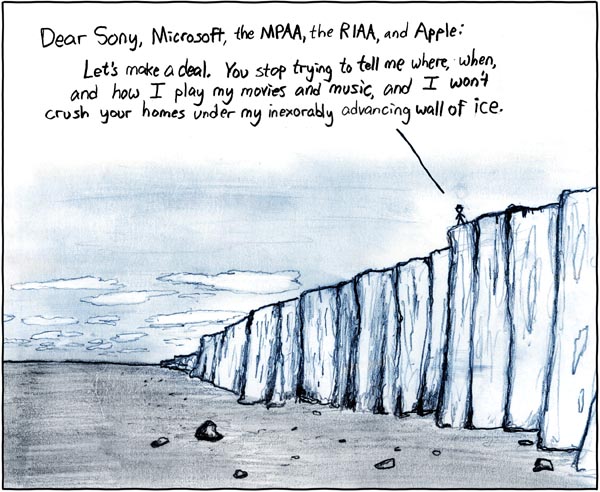
If this isn't enough for you, the domain WallOfIce.com (which redirects to the W.A.S.T.E. store) was created on the 14th of August - the same day as the track's leak - and has the registrant's whois information clearly visible:
Registrant: Versio
Contact: Reshad Bashir () +31.0645252730
Address: Raaigras 271, Leeuwarden, 8935 GD, NL
Reshad Bashir is a sysadmin for Versio, so he (or his company) has registered this domain on behalf of someone and his details have been put in there. Stereogum's already discussed this at length. No scene group member would be stupid enough to put personally-identifying details into a public whois record. Radiohead haven't registered the domain name directly, but it would make sense not to do so in order to stir up a bit more discussion and controversy over what it exactly means. Of course, this may all just be coincidence - someone registering the domain *after* the leak was made available on the Internet, and not done by the band - but it seems somewhat unlikely.
For the record, the most recent Radiohead scene release from an official group is a webrip of their Harry Patch tribute single: "Radiohead-Harry_Patch_(In_Memory_Of)-(Web)-2009-SiREx".
Summing up, these events can almost certainly be taken as proof once again that Radiohead are: 1) masters of drumming up Internet buzz, 2) completely in touch with their inner nerd, and 3) they 'get' the Internet a little more than some might think. They've always been in touch with their online presence; waste.uk.com was registered in 1998, nine months before even I had my own web site. Since then, they've overcome their signing to EMI, they've rapidly embraced the Internet and they've even conquered the question of variable pricing by just forging ahead and doing it off their own backs.
Now they're mimicking the release scene... Perhaps we'll see more future Radiohead releases leaked in the same way? They're certainly not the first band to leak their music via the Web, but it's quite clever of them to do it in such a way that it'll almost certainly fool those who aren't completely familiar with the usual behaviour of the MP3 release scene. Really, you can only commend the band for trying something new - this is guerilla digital marketing, and there's no telling just how much coverage they'll get from this once the mainstream media picks up on this. Personally I'll be very surprised if we don't see an EP release next week.
An aside: I have one problem with Radiohead's digital releases - if they're still using GoGo-no-coda, which is based on a version of LAME dating back to 2004, the sonic quality of their MP3s (even at 320kbps) is going to be vastly inferior compared to if they were encoded using the very latest stable builds of LAME. For this reason alone, I'll keep on buying CDs and ripping them myself (usually to FLAC).
(PS: if Thom / whoever encodes the MP3s for sale: drop GoGo! It's obsolete and the version of LAME it uses has been superceded. Get Frontah, drop in the v3.98 stable build of lame.exe into the Frontah working directory, and if you don't want 320kbps files, use the encoding paramters "-V1 --vbr-new" to encode your audio to transparent VBR files. Mmmm, sounding tasty!)
Update, 16/08/2009: someone at The Guardian has written a woefully mistake-ridden article on the same thing - and stupidly linked to the torrent on the private tracker what.cd as well. Read and enjoy: http://www.guardian.co.uk/music/2009/aug/14/new-radiohead-song
ITU Quickie: Amazon.com offering $1 MP3 download credit with qualifying purchases
0 comments at Tuesday, May 19, 2009While digital sales are continuing in their year-on-year upward trend, it seems that customers still need a gentle push to buy digital music. Even one of the largest digital music retailers, Amazon.com, is having to effectively subsidise purchases with their latest promotion. I saw it sneak onto the web site for some items yesterday; the skinny's on their web site but here's the 10 second summary:
There are some other T&Cs, but that's about the gist of it. The promotion's only valid on certain marked items (for example this DVD-Audio release of Elton John's Goodbye Yellow Brick Road), but it seems to apply to a good proportion of Universal's featured Motown releases as well as other popular stuff from other labels (the promo was also present on the SACD version of Dark Side Of The Moon).Add at least one qualifying CD, vinyl, cassette or DVD music item offered in the Amazon.com Music store to your Shopping Cart and complete the purchase or complete the purchase through 1-Click ordering. The music items that qualify are CD, vinyl, cassette and DVD music items offered in the Amazon.com Music store that display the offer message on their product information pages. Amazon MP3 music downloads and other music items not displaying the offer message, and all other types of items, fail to qualify for this promotional offer.
After completing your purchase, you will receive an email indicating that a $1 credit for Amazon MP3 music downloads has been applied to your account automatically.
So, maybe an excuse to do some shopping?
[Update, 27/07/2009]
As this article is proving to be one of the most popular on ITU, and it's REALLY long, I thought I'd add a quick menu to allow you to jump to the key sections.
Article Sections
2: What's in an album?
How much does it actually cost to press an album? Well, here's an accurate breakdown of the usual costs, plus a comparison with a digital release for comparison.
3: The Cost-Benefit Calculation

Here in the UK, Tesco is arguably the most aggressive major retailer. They have fingers in many pies; after running rampant through the usual grocery and non-food sectors through their chain of supermarkets, they rapidly expanded into many other sectors. In no particular order, these include "non-food" items sold in supermarkets (washing machines, toasters, kettles etc), online grocery ordering delivered to customers' doorsteps, followed by direct-to-home sales, again delivered to customers' doorsteps.
This is just the tip of the red and blue iceberg - go to their web site and explore a little to see just how many projects they now run. Tesco isn't the only major supermarket chain trying to make inroads though - Asda also has a fairly formidable online presence, followed closely by Waitrose, The Co-Op and Sainsbury's. However, if you come to the UK, the Tesco brand is fairly ubiquitous given their market dominance throughout the mid-90s right into this decade.
Enter Tesco... Image credit: Building

A couple of years ago, Tesco began to sell digital music via Tesco Digital. To begin with, their service solely offered DRMed Windows Media format - today they sell MP3s and DRMed WMAs for many albums, along with a selection of TV and films in DRMed WMV format. According to Tunetuzer Tesco Digital's bitrates are 192kbps for WMA, so logically their MP3s will be the same.
Now, while Tesco is a massive force to be reckoned with in regular retail, they have to largely play by the rulebook when retailing digital media, due to the requirements to pay mechanicals and whatever other royalties mandated through their arrangement with the various labels. According to the MCPS' current ratecard, the rate for downloaded audio (JOL) is 12%. Tesco Digital sells their tracks at 77p per track - when you consider the cost of an iTunes purchase was (until very recently) 79p, with iTunes Plus coming in at 99p/track, this doesn't leave much scope for profit by anyone's measure.
So, what really perplexed me was when Tesco decided to sell the new U2 album. They must have figured that it'd make a good loss leader, because in the opening week of sales, No Line On The Horizon went on sale for a measly £3.97 - if you purchased the whole album in one transaction. Individual tracks were, and still are, on sale for 77p each. Over the course of the next few days, they lowered the price even more - to just £2.78! However, it's currently on sale for £5.46, which equates to a shade over 49.5p per track when purchased as one album.
Quips about the true value of U2's music aside (personally I think it's worthless), this is very interesting. A major retailer prepared to experiment with some radical price cuts in order to drum up business? Is the demand that low for digital music? We continue to hear proclamations of year-on-year increases in digital music sales; heck, in 2005 the IFPI reported sales of $1.1bn, three times that of the year before, with The Register remarking that actual profits from those sales was probably closer to $280m given the apportionment of royalties. By 2008, the 2007 sales estimates were around $2.9bn, and in January this year sales figures were up once again to $3.7bn; "internationally... a sixth year of expansion."
I am all in favour of the music industry making money through legitimate retail, and through reasonable levying of royalties on those sales and performances. However, impressive statistics from industry bodies aside, there remain some important - crucially important - considerations for consumers with regards to the perceived value of digital music. Is the 80p mark for a digital audio track still too high? I began to wonder whether Tesco were experimenting with seeing if customers purchased tracks if the offer was appealing enough, based on their own perceived value of the music on offer.
I will readily admit that I am not your 'garden variety' consumer when it comes to digital media. I am well aware of the alternatives available, both legitimate and 'grey area', and in the past I've usually relied on the latter for music discovery - I have, in my many years of digital media consumption, only ever purchased one digital download (a charity single for Pirate Day last year, from the DRM-free indiestore.com).
However, I still buy many CDs (and a shedload of vinyl), and I do all my own ripping, encoding and transfer to my customised DAP (which is not an iPod - it's an iRiver H340, running Rockbox). While this puts me in a smaller camp of people who are a little more 'exacting' with where they obtain their digital media, I like to think I still have a solid grasp on the purchase habits of the majority of music fans, both ardent and casual. There is no denying that the ubiquity of iTunes+iPod is a strong market force, but Amazon's digital music service has a killer triple threat: massive brand awareness, higher audio bitrates (256kbps) and total platform agnosticism. Every digital audio player available today, including iPods, will happily play MP3s.
That said, iTunes has recently rolled out a store-wide upgrade of all audio to iTunes Plus (which also removes the layer of DRM from the audio, but increases the price). However, the quality is not that much higher - 256kbps AAC, which is on a par with Amazon's offering, but not playable on many players other than Apple's (but Apple's closed loop of iPod+iTunes is at once their biggest strength and their greatest weakness). There are other digital retailers in the UK marketplace, including some on par or competing with iTunes, AmazonMP3 et al (Play, 7digital and TuneTribe spring to mind), but today the market is saturated with hundreds of legal online retailers.
Now some of the avenues for legal digital music have been discussed, I can move on to the key point of this discussion - the true cost of digital music. What follows is a case study based on my own empirical research and first-hand experience, and is a fairly accurate representation of the costs a label faces when retailing music online. But first, let's break down the cost of a CD...
With CDs, the biggest profits have always come from economies of scale. Once your CD is mastered and sent for pressing, the manufacturer can just as easily press 1,000 units as they can 10,000. If we take a scenario which I'm sure many smaller/indie labels are faced with when they produce a new CD, the costs will most likely be similar to these...
Artwork:
- Barcode: ~£10 (although many labels will have blanket arrangements with the de facto provider for barcodes in the UK, GS1)
- Artwork design: negotiable, sometimes done in-house
- Artwork print planning: I've been told estimates of £300 for smaller runs (runs of <1,000)
- Cost per CD: usually between 0.15p and 0.25p (1/4 of a penny, not 25p). Prices can be as low as 0.11p, but only for multiple million unit pressings.
- Booklet: depending on page count and complexity of artwork and page arrangement, for 12 page booklet can vary between 0.20p and 25p for the first 1,000, roughly half for 2,000 or more.
- 8 page booklet: price decreases by ~1/3
- 4 page booklet: price decreases by ~2/3
- Slip case / O-card: between 0.20p and 0.30p per unit, loose or shrinkwrapping is between 0.01 and 0.04 per unit (NB: most shops will not stock items if they are not shrinkwrapped)
Delivery costs: negotiable depending on arrangement with pressing company, often between £30 and £50 per 1,000 unit run. 500 units not much cheaper - CDs weigh an absolute ton when they're boxed 20 to a carton with 20 or more cartons in a box!
Doing some quick sums, just pressing a 1,000 album might well cost around the £450-470 mark for a label, which is a good wedge of cash by anyone's measure. Then there are distribution costs, promo costs, and other costs (especially if an artist has an advance as part of their contract).
Another important thing to consider are the MCPS costs (the mechanicals) - a mechanical must be paid for every CD produced, and this is arranged by way of an AP1/AP2 licence from MCPS. If the label doesn't have one of these arrangements, they are falling foul of copyright law. Smaller labels have an AP2 or an AP2a - the difference between those being the payment terms (AP2a deals allow a label longer to pay the royalties, which can be crucial for small runs or albums which sell a steady amount but over a longer period of time). The royalty to pay is around 20% based on the net price - not the Recommended Retail Price the customer sees, but the lowest price. Net Realised Price is a term commonly used to describe this amount. NRP itself is based on the PPD (or dealer price), which is what the retailers pay to buy the stock.
There are also often 'file discounts' - the major labels will generally have smaller file discounts than the indie labels because for indie labels, the balance of power is firmly in the retailer's court (so the label has to effectively sacrifice more profit to get their stock purchased and sold in the shops).
Returns have to be taken into consideration as well - if many units of stock do not sell, the label has to ensure that they have enough money in the pot to refund the distributor or retailer after the returns are completed. This can often take several months, causing major complications and frustrating periods of little income for artists who are signed to smaller labels (because if the artist was paid by the label based on every single unit of their CD being sold, but half of the stock was actually returned by the retailers, the artist ends up owing the label money!)
I may have missed some aspects out, but they are the main things to consider for physical releases. Now, compare all that to considerations for digital releases of the same material:
- Banking charges when money from sales is passed on to labels
- MCPS mechanicals (yes, you have to pay a 'mechanical' royalty on every digital sale! This is usually incorporated into the cut the retailer takes from each sale)
- Other digital store fees (most stores will take a cut of each sale, in late 2008 iTunes was paying about $0.70 of each track sold to the label but this can and does change)
... and that's it. No production costs other than the artwork (which probably already exists if the album was simultaneously released on CD), a bit of promotion and the usual promo costs if the label engages in promotion.
The cost-benefit calculation
Digital versus physical, sound quality and the eternal value for money discussion...
Yet, although digital sales are relatively uncomplicated by comparison, how come they still cost so much? With CDs you get the original quality audio which you can encode yourself really quickly with iTunes/Windows Media Player/your software of choice (I use EAC & Lame for top quality). You also get artwork you can hold in your hand, liner notes, and a nice case to put on your shelf. You really do get what you pay for - whereas with iTunes or just about any other digital music store, you still get far less for paying about the same amount as the same music on CD. There are only very few digital music stores selling audio in lossless format - and aside from Beatport and Bleep (and a few other boutique retailers), all of the lossless digital music stores focus on classical and jazz; Passionato and Linn Records are two notable examples offering exceptional quality music (which itself is stunning) in a variety of formats to suit the listener.
Why aren't more labels and retailers pushing for this progress to be made? Who knows; maybe the mentality of "every downloader is going to steal and share their music if they buy it" is still prevalent - but people have shared music for decades! How else do other people hear about new music? And also, the attitude of music listeners being treated as 'consumers' as opposed to 'customers' is still worryingly present in the music industry. People do not treat music like they treat groceries - therefore it is inaccurate to classify music fans as 'consumers' when they are nothing of the sort.
Returning to the issue of sound quality - classical and jazz fans are regarded as appreciating high quality sound more than regular music fans, but that is not an excuse for all mainstream digital music stores to offer poorer quality audio. The BBC is currently implementing AAC+ online streams for its radio stations - you can already listen to songs on Radio 1 or Radio 2 in higher quality than you can by paying for them and downloading them, and amazing services like Spotify already offer high quality VBR MP3 tracks available to stream immediately for no cost to the listener - again, the quality of these is usually higher than the quality of the same tracks from many music stores. Services like Spotify, now launched in the UK, should be highlighting the need for the industry to step up its game and offer something to the customer which is a true deal-breaker - lossless audio would do that for me. The quality of the audio file, and the assumption of DRM schemes that you will infringe copyright (as opposed to the trust model which has worked for CDs for years) are my main reasons for still not buying digital music.
The fact that the music industry and the incumbent digital music retailers have not already pushed through parallel offerings of the same music in a lossless format to me is nothing more than legalised theft by another name. Lossy files (such as found on iTunes, TuneTribe, Tesco Digital and many other major players) should be priced even cheaper than they are now, particularly if they are DRMed - and the lossless files should be sold at the original price. Why? Well, with lossless audio, if you burn it to CD, you have an exact replica of the original audio, not a poor imitation of the original audio. Even iTunes Plus is an awful bitrate - 256kbps AAC? Not good enough. Apple already have Apple Lossless in their arsenal, but they're not using it - and there's also the popular FLAC, Shorten and Monkey's Audio codecs for lossless music. Sure, the files are larger - but you can burn them to CD to archive them, and encode MP3s, WMA or AAC files for your portable device from the originals after you purchase them. Heck, these days, with the cost of storage going down all the time, it's ridiculous to not have less than 500Gb of storage in your computer. Who cares how big the files are?
In my mind, if I'm paying as much as I would pay for a physical copy of the album, I want to get exactly what I would get sound quality-wise as if I was buying the original CD. Lossless digital files allow me to at least burn them to a CDR and enjoy the music at the same quality as if I was listening to a store-bought CD; as more and more people get familiar with the poor quality of downloaded music, they are beginning to realise that there is a big gap in quality between digital downloads and the same tracks on CDs.
With digital distribution, the costs to labels and distributors are far lower, so where are the profit margins being eaten up? I still believe an album purchased in digital format should cost far less than it currently does. Some in the industry would then argue that by pricing music any lower than it currently is, it devalues the creative output of artists to the point where it effectively becomes little more than a commodity. I would counter that for years, the music industry itself has itself done just that to music without any help from us - just look at the output of the major labels; there is the occasional gem but most of it is repetitive drivel which quickly gets forgotten about.
To sum up, do I think the price of £4 for U2's latest album in digital format is a fair and accurate price for the actual value of what you're getting? Yes, yes I do. However, the costs that the label and the retailer currently have to either pay or absorb (resulting in them selling at a loss) are still far too high. The structure of royalties and compensation for digital sales needs to drastically change before any real progress is made in digital retail - and while this is waiting to happen, people will continue to download music from the web in much higher quality without paying for it at all. Once the happy medium is found, most people will move away from buying CDs altogether - and there will be more profits for everybody. It feels to me like all the major labels are waiting for somebody else to make the bold move and give it a go - and in that kind of Catch 22 situation, we are never going to make any progress.
Will people disagree with what I've said here? I'm sure some will. I am approaching this from the perspective of a consumer who still feels like they're not getting their money's worth, not from the stance of someone working in the music industry trying to earn a crust. (It is not the framework of label + artist which is faulty, the entire system is outdated and needs a rapid kick up the backside to get it updated for the 21st century.)
Final Thoughts
The irony of all this is that if the U2 album was offered in lossless format for 99p a track, you would actually be getting your money's worth because once you have that lossless audio you effectively have your own copy of the original audio CD. The distribution and production costs are far less for everybody involved - so there's still savings to be had. You are also effectively future-proofed as a customer; when a newer audio format becomes the most popular one out there, you can just reencode your audio into that format without having to pay for it all over again. Everybody who has their music collection on CDs already does this, but everybody who buys from locked in platforms like iTunes is effectively screwed. As an insightful person wrote, quite pertinently;
If a digital music store doesn't give you a lossless copy, then it should provide you the ability to upgrade to a higher quality lossy format at any time.... And I could not agree more.
The alternative is that they haven't sold you right to listen to the music; just a scratched version thereof.
I hope this article has given you something to think about, and has maybe even persuaded you to reconsider your stance towards digital music and CD albums. I will keep on buying CDs (and vinyl) in shops until the day lossless audio is available to buy for an equivalent price in the format of my choice. What I really want to know is why labels and stores have been dragging their feet for such a long time about this - and why people are still tolerating this inadequate level of quality from digital music retailers. We're in 2009, not 1999.
In the meantime, there's just one thing I encourage everybody to do: demand lossless music from your music label or retailer! Only by asking these questions again and again and raising awareness of this whole issue will we as customers get what we want (and don't forget, the customer is always right). The music industry should be beholden to its customers, rather than the other way round - and it's about time we force the industry to rethink some of the rules to ensure we continue to get a fair deal. After all, when nobody pays for music...


