... I can't wait to give it a spin and see how it compares! Update (29/08/2007): I've had my Fontenna for about a fortnight and I've put it through its paces, doing a writeup at the moment. :) I guess there's advantages to being a Fonero and a long-time Fon user; I got my La Fonera for gratis (I managed to invite myself and get a free unit! so it wasn't quite one of those 'press review units', haha) but the promo code arriving in my inbox to get a Fontenna for just €2 (plus delivery) was definitely something I couldn't ignore!
If you're a keen geek, you'll most likely have already read the (badly) translated Engadget China review of their own Fontenna, but, you know, it's always nicer to have a natively-written English version. Other excuses for doing my own review? Manufacturing tolerances, different signal transmission capabilities of EU-licensed kit versus Chinese kit (which is probably only FCC-approved instead of both FCC- and CE-approved, if there's different models) plus subtle design differences... The wall wart has different pins on it...
Mine'll have nicer pictures.
Ok, off to bed for me - working nightshifts at the moment, 10pm-7am weeknights. They're horrible things - but oh well, needs must! I'm a student therefore my bank balance is in constant need of replenishment, and we students'll do almost anything for a bit of cash!
If you're one of the many non-US customers who used to enjoy streaming music from Pandora who were subsequently barred from using the service, give Soundpedia a go.
A more comprehensive Soundpedia review can be found on TechCrunch...
Apologies for the problems with the images in a few of my posts on here (including the iPlayer review), they're hosted on an external server and it's having a bit of a fit right now. My provider knows about it and is "actively looking into resolving it" (which I suppose means they're thinking about doing something as opposed to actually doing something... Sigh. Time for a cuppa!)
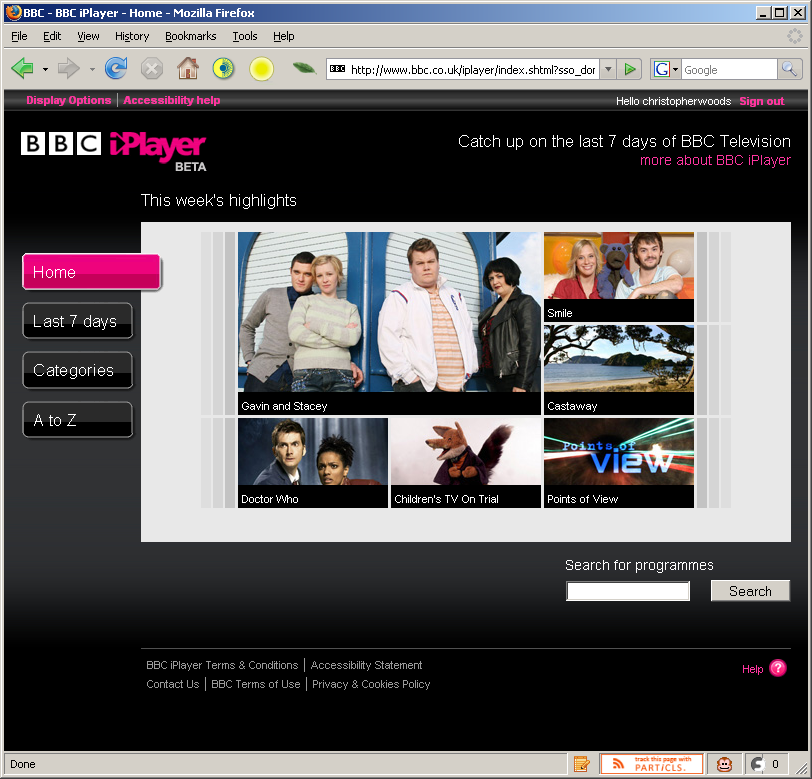
The BBC first started its trials of its nascent iPlayer service quite a while ago; unfortunately I wasn’t lucky enough to register my interest for the first trial, and so didn’t get onto the list of testers, so I have no knowledge of the first incarnation (and hopefully you’ll forgive me if I don’t make any comparisons between the first and second versions). However, I was quick enough off the mark this time round to register my interest and get accepted onto the trial, so here we are!
The iPlayer system is currently operating as a closed, ’walled garden’ system, with an extra layer of authentication on top of the regular BBC username system, and all beta testers allocated their own login for this walled garden area. The forums are similarly walled off at the moment during the trial, but are a part of the wider BBC messageboards network (my existing BBC login works fine).
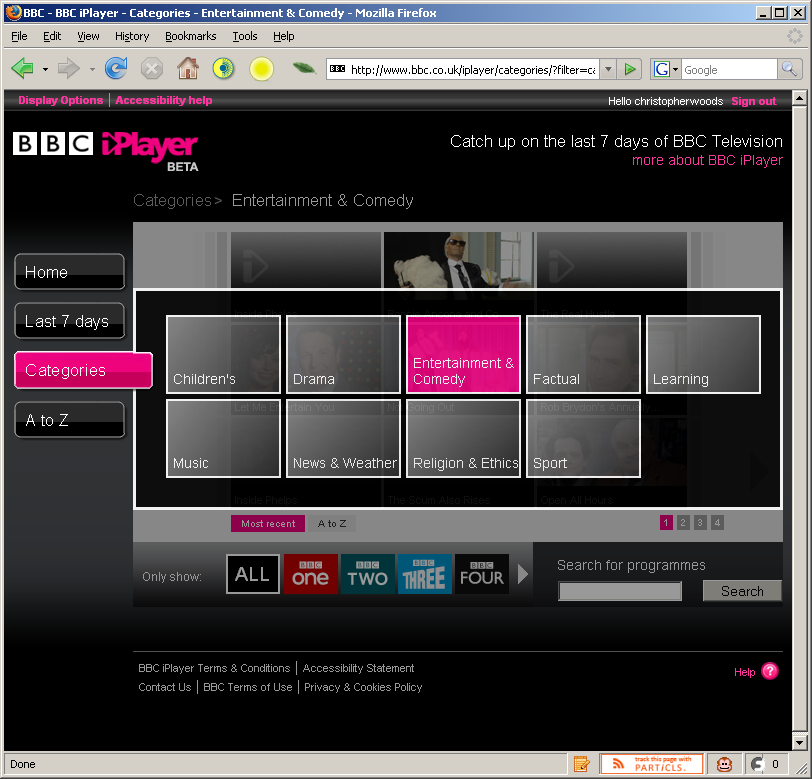
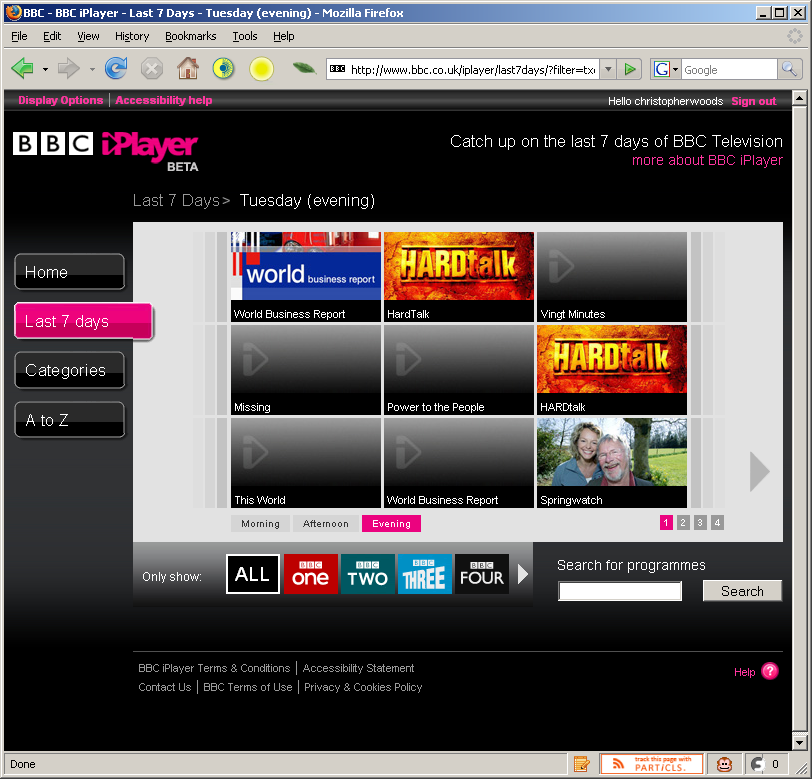
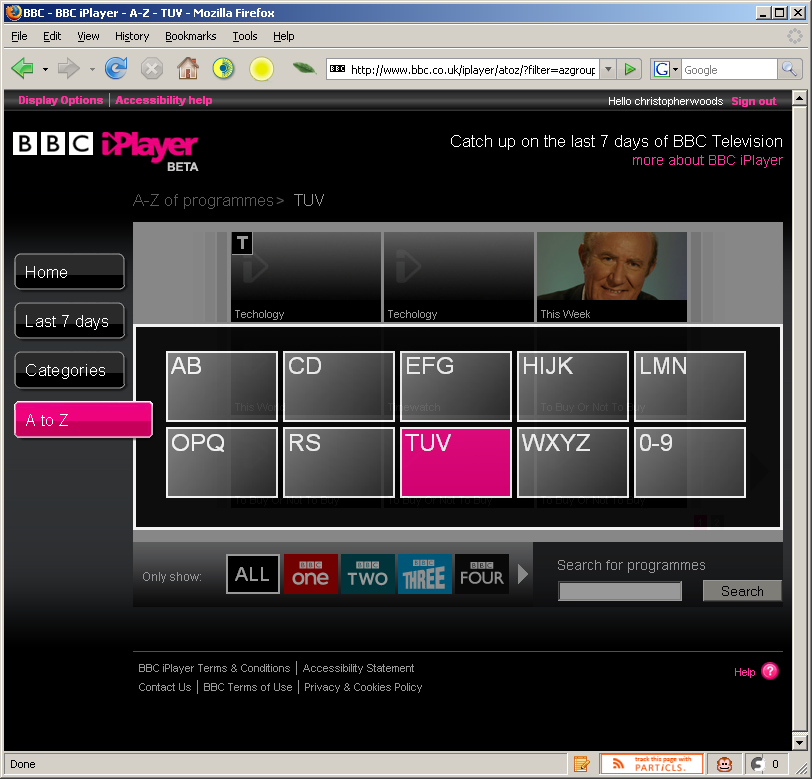
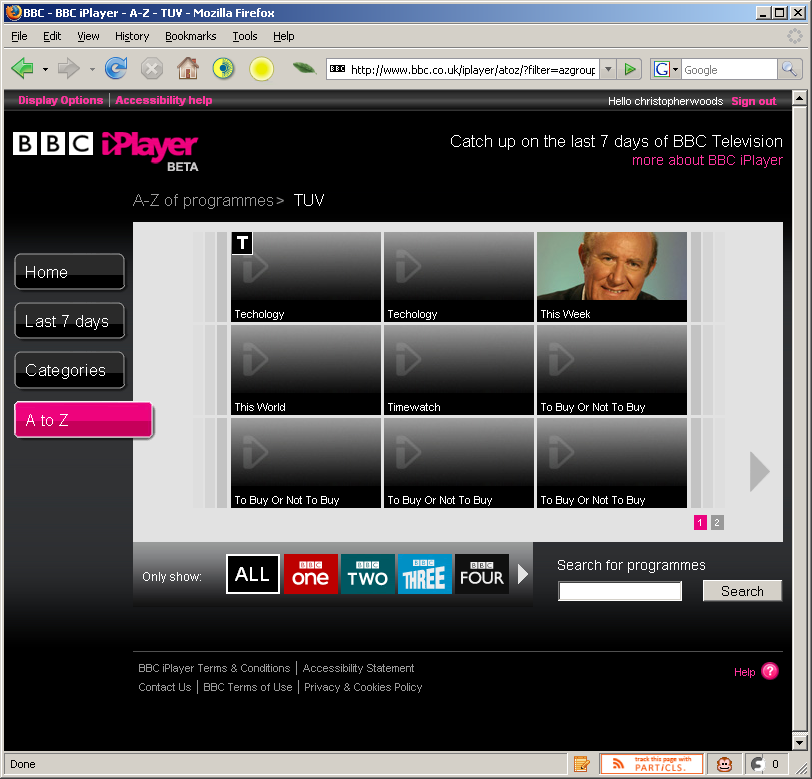
The system works in two parts - a desktop application and web site. The first, a customised Kontiki client - named the BBC iPlayer Library - stores and manages your downloaded programmes, as well as arranging the DRM license authentication for the content you download. The second part, the BBC iPlayer website itself (bbc.co.uk/iplayer) is where you choose what programming you want to download. The web site has a series of menus - organised by programme category, by day (7 days in total from today back to last week) and also alphabetically. Due to compatibility issues with the Kontiki Javascript libraries, you have to use Internet Explorer to actually choose and download content to your iPlayer library. I used Firefox for some of the screenshots as you don't need to use IE just to view the site (so apologies if you get confused by that).
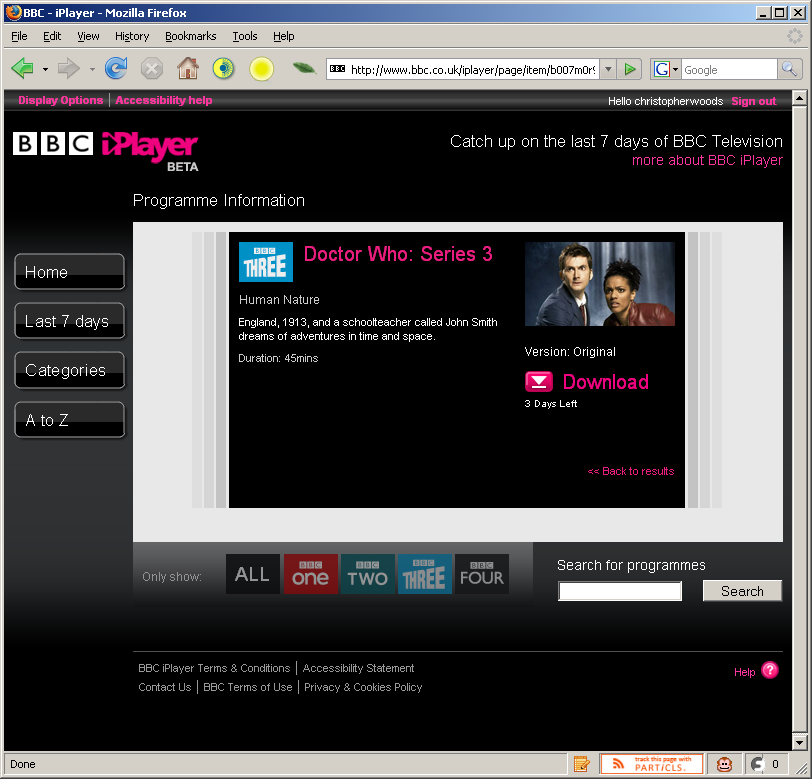
When you click on a specific programme, you are presented with a brief synopsis of the programme, how long you have left to download the show and details of what version the programme is (for some programmes there’s a regular version, a version which is signed and/or a programme which is signed on-screen, and you can choose the version you wish to download from a dropdown list).
The iPlayer entry for the "Human Nature" Doctor Who episode
The site’s not perfect - there’s problems with content appearing on the site but which users are unable to download (error messages being displayed), some content not appearing at all, and some content being incorrectly encoded (incorrect aspect ratios, etc) - but what do you expect, this is a trial! The feedback from the iPlayer team on the messageboards is very promising, and feedback is usually addressed within hours, days at the most - they also occasionally send out emails concerning platform updates or major bugfixes, so they’re obviously taking a proactive approach (something very nice to see).

The example to the left shows the Display Options preferences for the web site with the default stylesheet - it’s simple to select another stylesheet and any changes you make are reflected in the realtime preview, so thumbs up to the BBC for that.
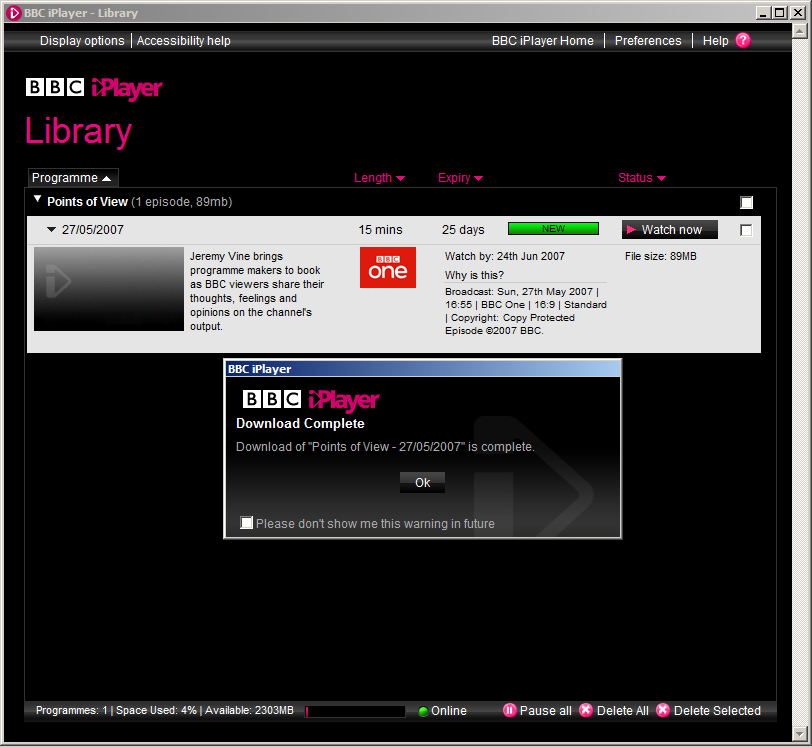
In contrast to the Sky Anytime and 4OD implementations of Kontiki’s download manager, the licenses are (from what I can tell) acquired at the same time as the actual video file, expediting the process of watching the content. Contrary to how I thought the iPlayer license acquisition works, the individual content licenses are obtained when the media file is played for the first time. For some reason, I thought the license might be downloaded alongside the media file (because I once received a license acquisition error at download time when the iPlayer service was having a 'hiccup'), but nope, license acquisition is definitely when the file is first played, bringing it in line with other Kontiki-based "on-demand" offerings from other UK broadcasters. Interesting that WMP doesn't show a popup informing the user of license acquisition (which my WMP is configured to), nor does it prompt for a username and password, implying that the Kontiki player passes along authentication variables when the file is first played. Thanks to my friend Jonathan for the hat-tip.
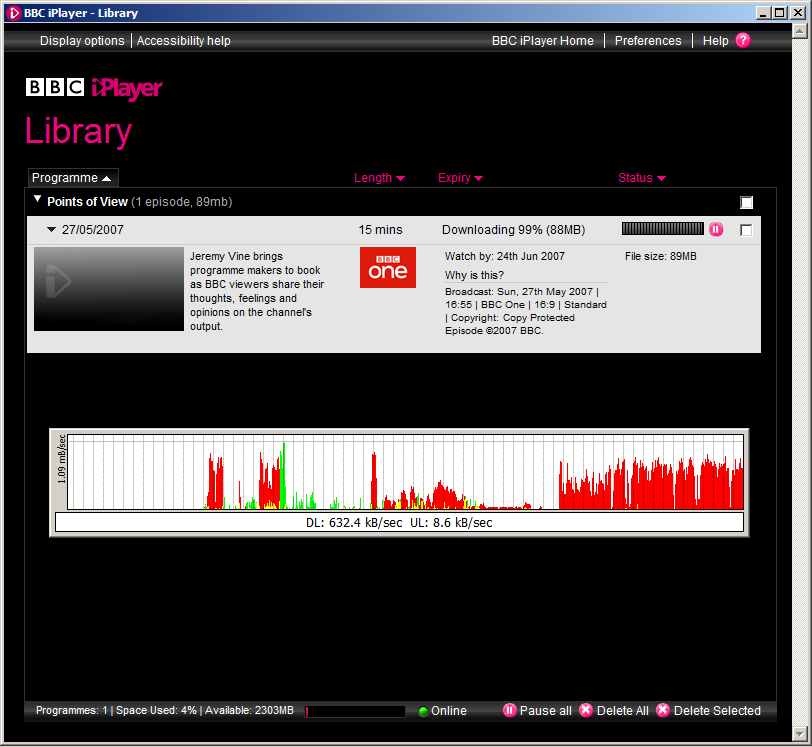
The iPlayer application downloads from both the BBC’s servers and other peers with the same video files, but - as you can see from the above screenshot - files zip along, maxing out just about any fast connection. My connection at the time of that download was a 10Mb ADSL2+ connection, courtesy of Be* Unlimited (theoretically they can provide up to 24Mb, and some users get that or in that region speed-wise... But, as always, if your BT line is awful quality, you’ll only get as good as the weakest link, something Be* have no control over). I’m currently switching to Virgin Media (nee Telewest) for their 20Mb broadband package, so I expect download speeds to top 2 megabytes per second as soon as we get switched over. I’ll certainly post any updates if things are drastically different.
There’s several steps - and timeframes - for content acquisition:
- After content is posted to the site, you have 7 days to download it.
- Once you download the content, you have 30 days in which to view the content.
- Once you have viewed the content for the first time after downloading it, you have 7 more days in which to watch the content to your satisfaction before it’s automatically deleted from your iPlayer library. You have no control over this, as it’s restriction of the (much-debated, but unfortunately - for the moment - necessary) DRM on all files.
Content itself is encoded in the Windows Media format, as it’s currently one of the only formats (and certainly one of the only mass-used formats, thanks to Windows Media Player) which supports the kind of time-limited DRM the various rights holders require of the BBC. I’m sure that eventually this will change eventually, but the question is where the next solution, which satisfies all requirements for platform agnosticism, will come from! The BBC is obligated by its remit to provide value in its efforts for as many people as possible, and there are many heated discussions about DRM and platform neutrality - in venues like the BBC Backstage mailing list, for example - so I’m unsure as to how long the current situation and implementation will last, given that it doesn’t support Mac users, is a bit patchy on Vista (the download manager has to be run in XP emulation mode), and only supports certain versions of Windows Media Player.
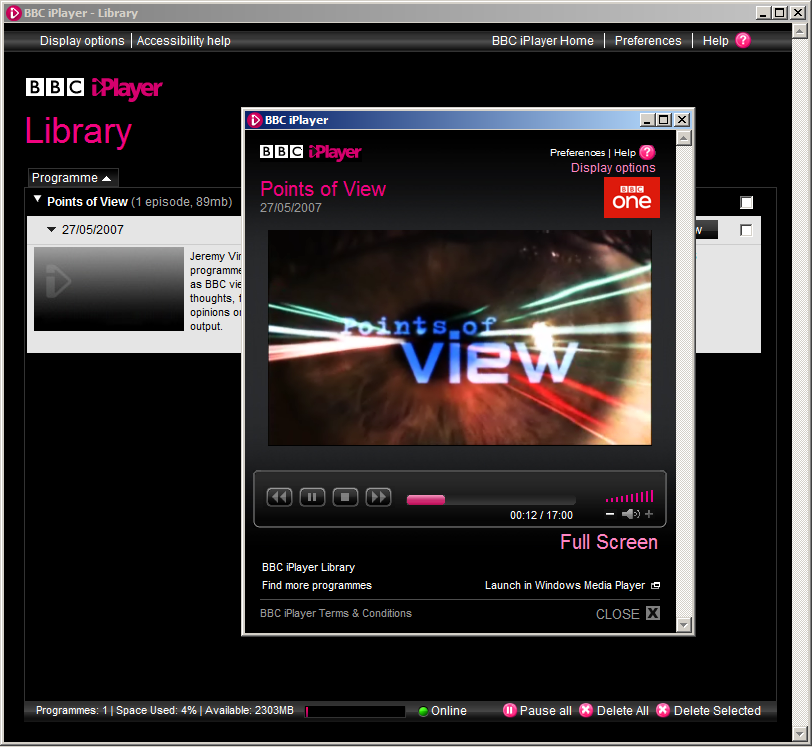
You can view content you’ve downloaded in two ways - via the iPlayer library interface, or directly in Windows Media Player (only on the same machine, currently, though plans for syncing to supported mobile devices is in the pipeline, apparently). The quality of the video files isn’t top notch, and it’s something I’ve whinged about on the iPlayer forums, but again I’m hopeful that as the encoding process is refined and the BBC improve their storage capacity for new content, the bitrate and resolution of the video files will improve.
Watching the videos fullscreen is perfectly doable, but you can still tell it’s a downloaded file (as is evident from this 1:1 portion of a screenshot of the above video file when played back fullscreen):
Jeremy Vine presenting Points of View... Great programme, awful intro music!

The files do come in at respectable filesizes, and I guess there’s already been a lot of wrangling over the quality-versus-filesize issue at the BBC before they even started pushing content out. I hope that they improve the quality though - the bitrate is only ~921kbps (of which the video is ~800kbps and audio makes up the rest)... Which isn’t good enough in my opinion given that by its very nature, the peer-to-peer framework upon which the iPlayer is built is designed to cope with larger files. My hope is that we eventually get several megabit, "DVD-quality" video files, especially as more people watch TV on their PCs (and in my case, am already watching HD content on my PC!)
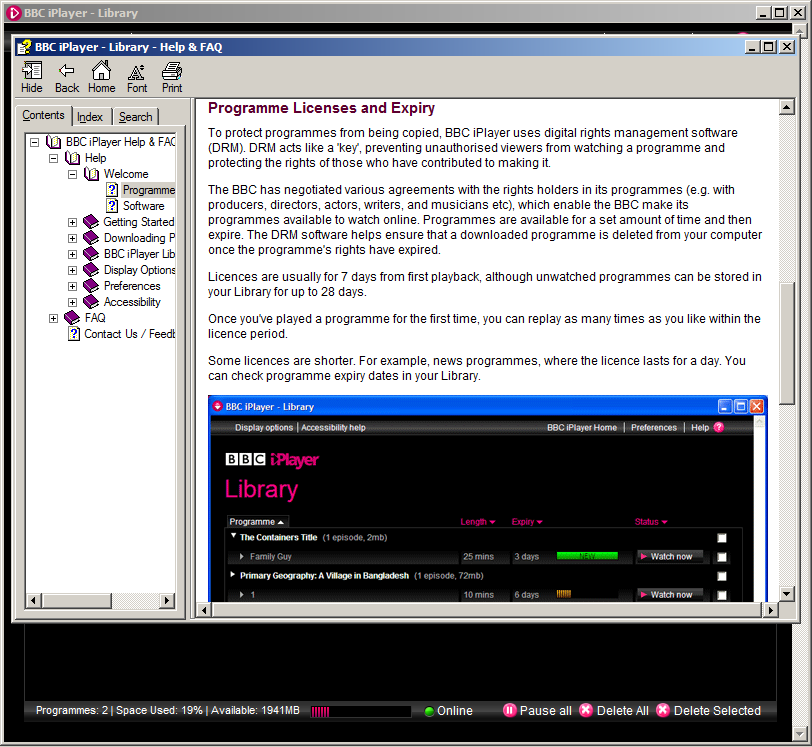
As a final plus point, the iPlayer software comes with a comprehensive offline help file - something too many application developers regretfully omit in this day and age!
The iPlayer help file entry explaining the necessity for DRM
All in all, I’m very impressed with the iPlayer platform, especially considering it’s still very much in beta. Sure, there’s problems (including files which are never actually available to download, entire days’ worth of content which has to be withheld from publishing because of encoding problems, occasional authentication problems, etc)... But these problems are being resolved and further improvements are being made, and I look forward to helping improve the application along with the other testers before it’s finally made available for all license-payers to use and enjoy.
If anybody has any questions, leave them as a comment on this entry and I’ll endeavour to answer them to the best of my abilities. I have no ETA as to when the iPlayer is being made public (probably because it has to officially pass its public value test first), but I can’t imagine it’ll be too soon given that ITV is rolling out streaming of its shows via the web site and both Sky and Channel 4 are increasing their online presence in similar manners. The BBC also has an Archive trial which begins soon... Keep your eyes peeled for that!
I'll have the new Harry Potter, a Calvin Klein watch and... Three boxes of Special K?
0 comments at Wednesday, June 13, 2007As mad as it may seem, Amazon(.com) has come a long way from its origins of hard- and paper back books. For a long time it's sold electronics, watches, healthcare items, later expanding into home and garden products, and even jewellery and clothing.
I received an interesting email from Amazon Associates this morning, though... And when I clicked through from the email, I was greeted with this:


 So, grocery? This was something I, honestly, didn't expect. I'm not overly shocked by their decision, I suppose it's only natural. Look, see for yourself - I'm not kidding. This is what Amazon itself says about this new service:
- We offer more than 22,000 non-perishable grocery items--and [their] selection is growing every day
- We can ship all products for free, via Super Saver Shipping, Amazon Prime, or free standard shipping
- We have great everyday prices plus special offers on your favorite brands
- We make it exceptionally easy to find products you buy routinely, or to discover new items we think you'll like
I'm a UK resident so Amazon Grocery hasn't quite made its way across the pond yet. However, I'm sure that when it does, I'll be one of the first to give it a spin and see how it fares. I'm not entirely sure what'd happen if I ordered a book and some Coco Pops in one go though - would they just squash the cereal into one of those book-sized cardboard packages?
What about if I ordered mayonnaise? Hmm...
Well, it didn't take long (I didn't think it would). Within two hours, a protocol handler exploit (including proof-of-concept) was posted up on the web, and then a handful of security researchers published the results of their own delving (mainly involving a stupid amount of fuzz testing to try and find weak points in the code). They turned out a fair few, less than I thought would actually be discovered (being the eternal cynic), but obviously WinSafari is still less than two days' old in the wild so I suppose there's more to come.
"It took all of two hours for researchers to find 6 bugs in the Windows version of Safari, 4 DoS attacks and 2 remote code execution bugs."
(via Wired Compiler)
Aside from the bugs in my initial impressions writeup, here's what's been found:
- The 0day exploit (found in two hours) by Thor Larholm (more info and PoC on his site);
- 4 Denial of Service attacks and 2 remote code execution attacks (found by David Maynor (yes, he of Apple WiFi hack) with free tools and a bit of elbow grease... more info);
And to top it off: - Many of the exploits also run on the OSX version of Safari, due to the shared codebase... Nice!
"It's clearly fast. Very fast. Like, noticeably fast, loading a half dozen sites (that take IE7 or FF2 a few seconds) within a blink of an eye. If nothing else, they've set the performance bar higher."
(via Hanselman.com)
... And you know what? I'm inclined to agree with him on this one. Obviously the rendering engine is a fast one, and as it's built on the open-standards WebKit framework with a bit of luck some other enterprising souls will come along and build a nicer-looking browser on top of the codebase, which would be perfect.
What holds me back from using Safari is... Well... I guess for one thing, it's the problem of it being an Apple-designed program for me. The forced Apple-style interface (ugh), the stupid layout and obvious skimming-over of standard Windows design (hello? top-left chrome menu?) and ignoring of design standards for the shortcuts, browser window design, missing features... Not being able to resize the window from anywhere except the bottom-left corner (where did the usability go?)
For me it's the little things with Apple's design conventions, and they all add up into a really frustrating experience for me. If Apple fix the bugs, standardise Safari's interface to match that of other Windows apps, maybe make it skinnable and retract their slightly pompous "Apple engineers designed Safari to be secure from day one" statement, I might consider using Safari on my laptop alongside Firefox, IE(6) and Opera.
Might.

...There it is!

The Apple Startpage, new and upgraded for its Win32 premiere

The chrome doesn't quite match all the way through...
Their preferences modal dialog is fairly faithful to the Mac original version, with a few exceptions (listed at the end of the article):...

Yes, IE6 IS my primary browser!
The browser buttons are obviously in "beta mode" too - I can't ever remember there being a Bug report button next to the Add Favourite button ;)

I've actually used that button a couple of times already, rock on beta status!
So, what next? Off to see how it handles Flash. Nice surprise: Safari is either using the Flash player for Firefox or IE which I installed a while back, or it has its own bundled player. Either way, YouTube loads fine:

Kubica survived that crash with just a broken leg!
My blog works fine too (yay), although for some reason the site title displayed in the tab only shows the part of the title after the exclamation mark (although the main Safari window title shows the whole title ("Kerblam! by Christopher") with no problem. That was another bug submitted back to Apple :)

My site, in Safari, on my laptop. Never thought I'd see the day!
For the hardcore geeks / web developers (who now have to code their browser-specific content for yet ANOTHER quirky rendering engine), this is what the Safari browser sends in its HTTP headers (for the geeks only):
For those who don't want to run the test themselves, this is Safari's user-agent string:

UAG = Mozilla/5.0 (Windows; U; Windows NT 5.1; en) AppleWebKit/522.11.3 (KHTML, like Gecko) Version/3.0 Safari/522.11.3
One nice touch: dragging tabs behaves just like on OSX, and even has the cool, alpha-blended mini preview mode...
Ok, so what about the bugs? Well, there's a few:
- Tabbed browsing isn't quite up to the standard of Mac-Safari; you can't Undo an accidental tab closure with Undo like you can in Safari 3 on the Mac (in Tiger and subsequent minor versions);
- HTML title detection doesn't seem to be quite perfect just yet, my blog's title (which has alphanumeric characters, then an exclamation mark, then more alphanumeric characters) only shows the part after the exclamation mark in the tab's title, though when the tab is active the main Safari window shows the full title;
- When composing a blog entry using Blogger's WYSIWYG tools, the Insert/Upload Image feature doesn't work - at all! The popup dialog doesn't even open, so that's obviously some kind of coding issue which Blogger are going to love fixing;
- When configuring the Download options, you can only choose a specific folder to download to, as opposed to being able to specify that Safari asks you for a download location for every download;
- When you download items, you have to double-click on the file's icon in the Download window to open the file, clicking on the filename itself does nothing (unlike Safari on Mac, where you can just double-click on the entire row for a file in the download manager to open the file). Hopefully this is just a minor UI flaw which'll be fixed in later releases;
- My laptop touchpad's scrolling feature doesn't work at all inside Safari. This feature, found on just about all Synaptics touchpads, allows you to move your finger up and down the right hand side of the touchpad, or along the bottom, to emulate mousewheel horizontal or vertical scrolling through documents. It's a software feature, and not all applications support it, but hardware mousewheel scrolling works ok. It's still an oversight though;
- Typing "safari" in the Run box doesn't load the app, so Safari is obviously not registering with Windows' PATH feature.
"You what?" you're probably thinking, so let me explain. Many Windows applications register with the OS allowing you to load an app by typing its 8.3 filename, e.g. cmd for a DOS prompt, mplayer2 for Windows Media Player 6.4 or wmplayer for WMP7 and above..., iexplore for Internet Explorer, winword for Microsoft Word). Again, this hopefully something Apple will fix in future releases, because I do a lot of loading apps via the Run box and it's a pain having to make shortcuts in the root of your C:\ drive to emulate this feature. Of course, shortcuts on the Quick Launch or main part of the Start Menu are another solution, but I do most of my computing via the keyboard, hence this preference for low-level application registration with Windows. - Probably the most annoying bug: you can't tab through browsers yet! Using the familiar Ctrl+Tab / Ctrl+Shift+Tab to tab forward/back through Tabs just doesn't work, with the focus being permanently stuck inside the currently-active tab. I'm a fervent fan of tabbed browsing, and I do most of my work via the keyboard (see why I don't like OSX? It's a much more mouse-centric OS, although I fully appreciate there's loads of mouse shortcuts, the UI was very much retrofitted for keyboard command imho), so this bug is probably the most annoying for me at the moment.
Flaws aside, and appreciating that this is the very first beta version, I think Apple have done pretty well porting Safari to Windows. You can download it bundled with Quicktime, or you can download it standalone (I downloaded both but already have QT installed, so why bother reinstalling?) and at a paltry 8 megabytes in size for the installer, it's hardly any real effort to download it. I had it up and running within two minutes of clicking Download.
Safari for Windows is going to be an essential install for any web developer's dev machine, and it sits quite nicely alongside your other browsers - and it plays nice too, not trying to hijack your 'preferred browser' settings if you already have other browsers installed (Firefox unfortunately does this by default with its default browser check dialog, appearing every time you start the browser unless you untick the box in the dialog and press No).
Apple have played it quite cleverly here too - most likely notifying many of the 500 million iTunes users (and the 1 million people who downloade iTunes every day) that Safari is available for Windows. Why bother with an expensive ad campaign when they already have what is arguably one of the most widely-used pieces of software in the world? Every time someone opens the iTMS, they see the landing page, and all Apple has to do is put a couple of prominent banner ads on there and bingo: people download it, and word of mouth does the rest. Bundling Safari in the iTunes installer packages will do the rest of the legwork for them.
So, marks out of 10? For now, 7/10. I guess that's a B minus on the report card; room for improvement but a good initial effort. Aesthetic improvements required, UI has to be fine-tuned, some of the application options have to be expanded or improved - but on the whole, everything works quite nicely for a beta version.
Considering the sheer size of the Windows userbase compared to the Mac userbase (and all of the various problems associated with amount of different system configurations), they must've had many problems to overcome. I've not noticed any major problems yet, and my setup on this laptop is a fairly well-customised XP machine with five browsers currently installed.
I look forward to these bugs being fixed so Safari fulfills my expectations, because there's not really many reasons for Apple having omitted to either code workarounds for them or just implement them like they already have for the browser's Mac counterpart.
Think I'm talking a load of rubbish, or want to try Safari for yourself? Download the beta version from apple.com/safari.
That fabled iPlayer beta trial review is coming soon...
Sorry I've been tardy with updates recently - just writing to say that I'm on the BBC's iPlayer and Archive trials, which should both start soon. I'm really looking forward to testing them out, seeing what they can do and how they perform, and I'll be writing in-depth (as far as I'm allowed, provided there's no NDAs like there was with Joost) about each one for the benefit of those who were unlucky enough to miss out on the first round of invites.
Should be fun... Also going to write a round-up of some other things, I'll leave you guessing as to what exactly that'll be about until I publish it (you'll have to wait and see!)
Until then...
I'm as big a big fan of HD content as the next geek, and I've found (as have many others) that on my PCs, along with AC3Filter and the Haali Media Splitter running the show for my decoding, CoreAVC is the most effective and efficient video codec for H.264/AVC content. However, in the CoreCodec discussion forums there's been lots of discussion about delays and widespread reports of bugs in the new version (1.3.0.0), including lack of playback once it's installed, incompatibility with Vista, and the inability to roll back to 1.2 once 1.3 has been installed - even if it's uninstalled.
The CoreCodec site, which has an online portal system for those who have purchased the codec (including personalised download links for the installers) is also in a state of hiatus, with all purchasing facilities suspended until the new versions of their most popular software - Coreplayer Mobile (formerly TCPMP, which I still use on my Vario 2) and CoreAVC - are bugfixed and compiled.
The CoreCodec developers have also commented several times on their forums that once the bugs are sorted out, 1.3.0.1 will be made available for purchase and everything will return back to normal, but the delays are increasing and feedback from the developers is less than forthcoming.
It's a shame, because CoreAVC is a really cracking codec - its performance on less-than-brand new systems is noticeably superior when put up against its main competitors, and all the processing is done in software as well - and I hate to see this small bit of bad press affect it. I have every hope that CoreAVC 1.3.0.1 will be released soon, as the developers promise. When it does I will be suggesting to the developers that they keep a closer eye on their (if small, but very active and vocal) community residing on their forums and on other forums like Doom9 so as to revise their code and fix problems much sooner. They are usually pretty good when it comes to fixing problems for next release, and their community acknowledges this, but equally this whole issue could also well be ascribed to taking a product out of beta a little too soon.
Conversely, Google loves its 'beta' tag, and applies it to just about everything (I'm still a little amazed that Google Search still isn't labeled as beta, as they're continually adding new features) - it raises an interesting question, too: given the possibility for keeping a product in continuous beta status, and releasing updates thick and fast as problems occur, is that a better practice for developers than to work a long time on fixing every problem they can foresee, releasing it to the masses then firefighting when a bunch of users come along with a new, unforeseen problem? The latter is what appears to have affected CoreCodec's product, but the former situation (thinking of Google again) also has the side-effect of devaluing the 'beta' status, and, in effect, merging together the beta and RTM levels of development until both terms have little relevance to their original meanings.
Maybe it's time for developers to rethink their usage of beta as a terminology for defining "it works, but it's not properly finished yet... But what the hell everyone, just use it anyway and don't bitch if it breaks on you", because it also - to me anyway - devalues the usefulness of effective Quality Control testing by a controlled group of testers. Every good product (should) have QC and QA performed on it at every major developmental stage, and usability tests to boot, otherwise you end up with a product which has been designed engineers without a thought paid to how regular users are going to use it.
The software which runs on 90% of the UK's checkout EFTPOS terminals (tills to you and me) is a prime example of software developed by developers without it ever having even a once-over from a usability engineer. That's possibly the most important stage of a software's beta cycle, and it's being neglected in this increasing trend of Web 2.0 "unfinishedness".
In fact, I think the beta tag should be dropped from many of the programs that use it, and replaced with a term like "almost" - that'd encourage developers to get it finished and out the door in a properly working state much faster than they do currently. Tagging something 'beta' almost encourages slower development, which isn't always good - last time I did something like that, I ended up spending weeks and weeks on it and continually losing my train of thought, which slowed down development as a whole and meant that I also lost some good ideas which I'd had but not started to work on.
Beta's not always a good thing to call something. Maybe beta-with-next-stage-deadline would be more appropriate for the majority of live, in-development projects I see on the web these days...
Where we once had
we now have
As of the 19th of April - two whole days ago, how did I miss this! - Froogle has been rebranded to Google Product Search. All the old URLs to Froogle still work though (even the one which only idiots ever went to), and that's how I'll keep on using it (frankly, Froogle was a much cleverer name in my opinion).
This also looks to be in direct contrast to the rumours that Froogle was to be wound down, with various rumours in the tech news now looking unfounded (and falling in line with kinda subtle confirmations that the Froogle shop wouldn't be shut for the foreseeable future, but various people interpreted the quite cryptic Google responses in their own ways). I'm glad to see it continue, even if under a new banner, because it's a really useful facility for consumers - even if it is a royal pain in the arse for shop-owners to add their products to.
This namechange is also in line with Google's rebranding, and re-announcement, of its Search History to Google Web History. Now out of beta, Web History (once turned on in the control panel) shows you detailed statistics and results for every search you've performed since monitoring began - in my case, back to May last year. As I don't keep my Blogger account signed in all the time (as I have two blogger accounts, one for my blogs and one for gmail) it's nigh-useless to me because the results are full of holes, but it's really interesting to look back and see what you surfed.
[To hit the mainstream] RSS has to become brain dead simple to use.
- Fred Wilson
Particls is well on the way to managing this, and this isn't something I say lightly.
The above quote was the first immediately-arresting thing I saw when I fired up the Particls web site a few weeks ago. Mind you, until recently (the 13th) it wasn't called Particls, it was called Touchstone.
"What the hell is Particls?" Good question. Particls bills itself as "personalised aggregation", or, in a sentence, automated aggregation which solicits your initial input to refine its scope, and then goes off and collates appropriate news.
Personalised aggregation IS snappier, come to think of it.
It's a desktop client, which, once installed and given a list of keywords to look for, just... Goes off... On its own... And reads the news. Sure, once it's read the news it then assesses it for relevance and then feeds back to you, humble user, providing you with relevant and (hopefully) interesting news articles from a cornucopia of feeds. Indeed, the Particls blog mentions such terms as "Personal Relevancy or Attention Management" to describe Particls (this is during a blog post discussing how Particls is not Web 3.0 which I found most amusing). The idea is that it (eventually) integrates with your calendar, email and web through a series of modular interfaces, displaying news items in popup alerts on your desktop which fade in and out. You have the option to close them sooner or sticky them with little icons in each popup.
This is what a popup looks like:

And this is how you define what you want it to keep a look out for - the Watchwords / Blacklist lists.
Watchwords

Blacklist (well, I had to put something to demonstrate, usually it's blank)

All this and more is accessible via one small tray icon - the menus are pretty well laid-out, so nipping round the options isn't much of a hassle.
You might think "pfft, this is a gimmick, unnecessary software which does little for me," but it DOES work! I just leave it going, if I'm busy and don't want to be disturbed I can set it either to a 'Low level of interruption' or define a custom level where I can choose individual thresholds for the news ticker, pebbles and popup alerts (or I can disable each one altogether, individually). That way I can avoid unnecessary procrastination when I'm trying to write my essays for Uni! The rest of the time, I just leave it on low or medium depending on how much I want to drift off whatever I'm up to at the time (because usually reading one interesting thing leads me off on a voyage of discovery around the web, usually spending 40 minutes or more reading around the subject). Particls achieves the best of both worlds: it helps me keep current with stuff I find interesting whilst not having to trawl around and manually go through RSS feeds looking for related entries to my interests.
There's a great deal of customisation available; you can define an 'interruption level' via the tray icon, and depending on the threshold, you can have a ticker along the top or bottom of your screen which shows news as it comes in, or you can just have occasional popups of relevant information.
There's also a very cool Web 2.0 interaction possibility with Particls: the Pebbles. By default, the Pebble adapter is disabled, but once enabled, it's like publishing your own "what I'm interested in" feed without having to manually update it all the time. Here's how it works:
The Particls Pebbles Adapter and Publishing Service is, by its very nature, designed to publish your Particls Item Stream to a publicly accessible hosted RSS feed. For this reason the Pebbles Adapter is turned off by default. Please note that opting into using Pebbles does make it available via the internet via an open RSS feed - we may add authentication later.
The main Particls Pebbles page has more information and suggestions on how you can use your own personalised RSS uberfeed, but this paragraph I feel highlights its usefulness in making 'your own personal Pebble':
Particls allows you to subscribe to information you care about, it learns what your interests are keeps you informed while you work. Pebbles makes Particls even more powerful by aggregating and syndicating your filtered Particls items to your very own RSS feed.
That's pretty cool by any stretch of the imagination! I do the work in the first place, the software goes off and checks out all that's available, sifts the chaff from the good stuff, and presents the end results to me for my perusal. Truly, this is RSS news how I've been wanting it to be for a long time now: just for me - all killer, no filler!
(If you got that Sum 41 reference... Well done... I think
I have 10 - yeah, ten! - invites to give away for Particls if you're interested in joining the small community of beta testers for this project. Just add your request (with an email address) to the comments page for this entry, and I'll fire you off an invite lickety split. Sharing is caring :)

So, what's this then? I found yet ANOTHER reference to a site whilst going through my site logs, this time to this IP - which also resolves as assista.com. There's no info, no pages, quite literally nothing on the web about it. What's it all about?
I'll be keeping my eyes peeled and ears pricked for news on this, it could be quite intersting. I wonder if it's anything like FreeIQ, which bills itself as 'The Marketplace For Ideas' (and which I signed up to earlier this week)? If so, that'd make it the third knowledge-based community site I've seen pop up in as many weeks!
topicblogs/0.9 (Or, TopicBlogs: vapourware or a potentially great service?)
2 comments at Saturday, April 21, 2007I just had that awful sinking feeling.
You know, the one where you think, "well, with hindsight I should have done a bit more investigating before I put my email address and name into a box and hit Submit on a webpage which has nothing more than a logo and the aforementioned form."
What the hell am I on about, you may ask? Well, a site called TopicBlogs. The site has nothing on it, and doesn't seem to have had anything on it for a while - maybe a startup which was shuffled onto the back burner, maybe something which is still in private testing stages, maybe something which is almost ready to be unleashed into the blogosphere.
I did some Googling, and found mixed information: there's a Jeff Chan listed next to topicblogs.com on a TechCrunch wiki page entry for a 2006 meetup in California - which would therefore logically imply that Jeff Chan is California-based, most likely in the Silicon Valley / Bay Area and working at a startup or incubator company. That said, maybe Mr. Chan was developing an idea on that domain, got bored and let it expire, and it was purchased to use for other more nefarious means. Maybe it's a legit site but is unfortunate to be hosted on a known-unscrupulous webhost (Layered Tech)...
...Maybe it's just a ruse to get people to put their names and email addresses into a database to get spammed, who knows (all I know is I saw a bot with that name spider my RSS feed). Whilst I write this I'm doing some parallel Googling to see if I can find anything more, and it looks like this might be a complex system devised by someone to crawl sites looking for Wordpress / TypePad sites, and then attempt to abuse the comment posting scripts to send them loads of spam. I found some fairly convincing evidence on PlanetMike's blog, and the most unfortunate thing is that that entry is only dated from the beginning of this month.
Oh well, there goes my address into the wild west of yet more spamlists (I already get a ton of spam thanks to my address being leaked onto the web via leaky mailing list archives). I also note that The Web Robot Abuse Blog notes that topicblogs is hosted on .layeredtech.com, which they already blacklist for known spam operations.
Darn it, why aren't I more careful with my email addresses sometimes? Oh well. Don't make the same mistake I did! Maybe it'll turn out alright on the night, maybe it won't. Stay tuned to see what happens.
There may be a ray of hope though (and I'm an eternal optimist); see what Nicholas Seow wrote in one of his blog entries, way back in 2005:
Apparently this crawler is linked to ping-o-matic, and is notified when you give ping-o-matic a RPC. This obviously means that topicblogs is some sort of blog-indexing service, or maybe a new social network service. It certainly gives the impression of a startup which has some sort of innovative idea they’ve yet to unveil to the world.
http://thom.org.uk/blog/Topicblogs.aspx has shown that topicblogs is somehow related to http://www.backweave.com/blog/, or Jeff Chan if the profile information is accurate. Yep, this definitely seems like a startup - a one-man mission, in fact.
Checking up on both the domains of topicblogs.com and backweave.com, we can surmise that both are owned by the same person, Tze Yi Chan, or Chan Tze Yi if we follow the Chinese naming sequence. No doubt this is the same person as Jeff Chan.
Well, I’ve been unable to find any more information, so I may just email them out of curiosity. Good luck to Jeff Chan in his endeavour, and his bot is welcome to crawl over all over the place here at propitiate.net, as long as I don’t find out anything nasty about it.
This information tallies with some of the other stuff I've already found myself, so who knows? One of life's great mysteries.
Perhaps it's just a big social experiment to see who responds to the feed scrapes and puts their address into the box... Who knows?
More references:
Thom.org.uk - topicblogs
Propitiate.net
LabNotes - Who's reading the blogosphere?
TechCrunk Wiki: techcrunh7 info (search page for Jeff Chan)
(Yeah, I know most of these articles are quite old, but that almost adds to the mystique... Such a long time without any real revelations... What could the site be? Hmmmmmmmmmm.)
Onfolio/3.0 Beta 2 ... (or, OnFolio: collaborative research and newsreading)
0 comments at Saturday, April 21, 2007I was going through the server logs on one of my (pretty much unadvertised) blogs (uniblog.co.uk) when I started noticing a LOT of hits from bots all calling themselves "Onfolio/3.0 Beta 2".
Since I'd never heard of this, I went exploring... Turns out it was a maturing web service which seems to aggregate online content and research which was recently acquired by Microsoft. From their site,
Onfolio is an add-in for the Windows Live Toolbar that helps you collect and organize online content, read RSS news feeds, and share content in emails, blogs and documents. With Onfolio, you get all of these tools built into your browser for simplicity. Whether you are planning a trip, looking for a job, investigating a major purchase, or simply looking for a better way to keep up with the news that interests you, Onfolio will help you be more efficient, thorough and organized.
From what I see, there's either existing or planned development of:
- Blogging and commenting integration
- News aggregation via XML/RSS
- Collaborative researching and sharing of information
- Creating an archive of files, research and other miscellanea for retrospective review
- Tight(er) integration into the browser to complement standard searching
... and more besides. There's loads of info on the OnFolio site.
I've had loooooooads of hits from various IPs in various subnets, but all with reverse DNSes ending in .as9105.com - one which I recognise from past experience as a Freeserve-now-Tiscali AS.
So, is it just pure coincidence that loads of (only) Tiscali users are using the OnFolio IE Search Toolbar plugin, or is there something else going on? All the IPs I checked out resolved to dynamically-assigned IPs in the ADSL ranges (194-247-239-150.dynamic.dsl.as9105.com [194.247.239.150] and 212-1-142-110.dynamic.dsl.as9105.com [212.1.142.110] are two examples) but for the life of me I can't quite work out why there's no requests from anywhere else aside from Tiscali subnets!
Anyway, this tool looks quite nifty - all the requests have been for my XML feeds, which I assume ties in with the ability of the software to aggregate news via RSS (go figure) but still, I'd not really heard about this at all and now all of a sudden looks like they're gearing up to a larger webcrawl to get their content together. And if they're spidering my little old web sites... They must be nearing out-of-beta.
So, go check out OnFolio - now owned by Microsoft (hiss) but it still looks fairly cool to use if you're into your inline toolbar widgets. There's also an OnFolio Group Blog if you're thusly-inclined, I'm pretty sure if you had any more questions about the service or where it's headed, they're all answered on there.